
Thailand's PM visits BYD as his deputy meets six Japanese carmakers: what Thailand won from both
Introduction
In our November 4 issue (in Japanese), I compared how Japan, China and Thailand reported Thailand's cabinet decision to raise the excise tax on imported EVs to 35%. It was the same news, yet the Japanese press presented it as a response to the influx of Chinese makers, while a Chinese outlet described it as rather a tailwind for Chinese makers producing in Thailand. Thailand's Deputy Prime Minister explained that the new tax system would bring a fairer competitive environment.
This is the follow-up. From November 17 to 20, Deputy Prime Minister Ekniti led a public-private delegation to Tokyo and met six Japanese carmakers one by one. As the results came out, I noticed something else. Japan and Thailand both use the same word, "fair", but what they mean by it differs slightly. Autos are a pillar of the Thai economy. Standing between Japan and China, what did Thailand actually gain? I look at it from the perspective of Japanese companies doing business in Thailand, or thinking about it.
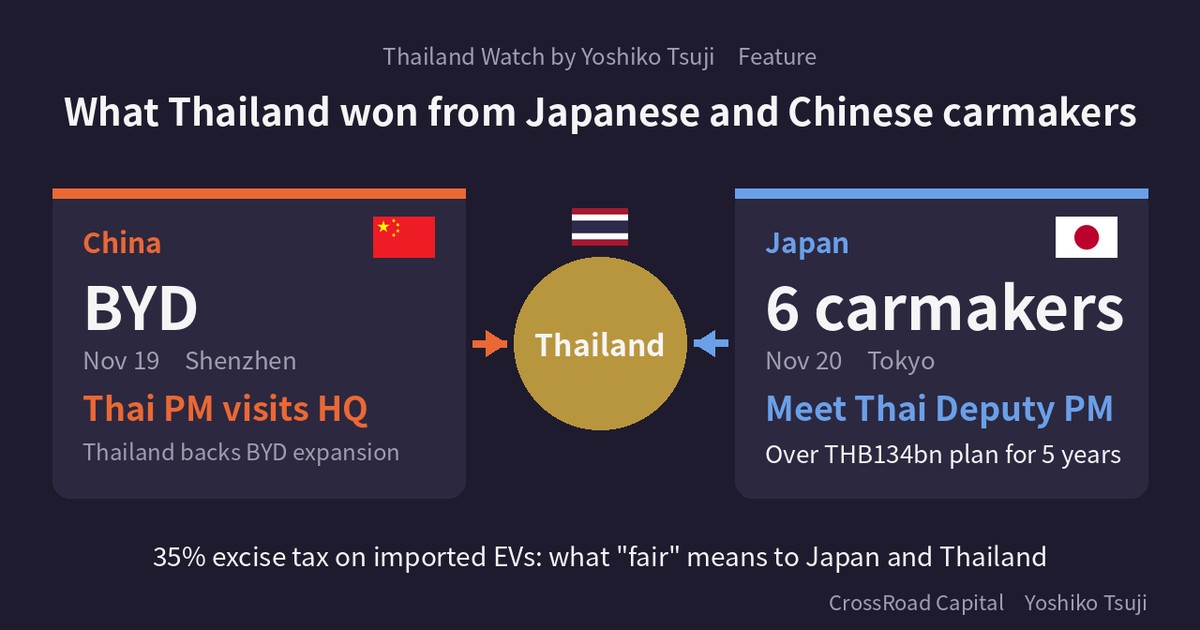
1. Same week: the PM with BYD in Shenzhen, the Deputy PM with six Japanese carmakers in Tokyo
- Prime Minister Anutin, attending the APEC summit in Shenzhen, visited BYD's global headquarters on November 19 and was welcomed by Chairman Wang Chuanfu (Thairath, Nov 21). The Thai government delegation led by the Prime Minister said it was ready to fully support BYD's plans to expand its investment in Thailand. After returning home, the Prime Minister said BYD had confirmed its intention to launch new EVs and keep expanding its investment (Krungthep Turakij, Nov 21). BYD sees Thailand as a strategically important market. Its plant in Rayong, BYD's first passenger-car plant outside China, started production in July 2024 and can make 150,000 cars a year (Krungthep Turakij, Nov 21).
- The next day, the 20th, the Prime Minister met Chinese President Xi Jinping in Shenzhen. Xi called for wider cooperation in areas including AI and new energy vehicles (Daily News, citing Xinhua, Nov 20).
- The same week, Deputy Prime Minister Ekniti met six Japanese carmakers one by one in Tokyo: Toyota, Honda, Isuzu, Mitsubishi Motors, Mazda and Nissan (Nov 20).
The Prime Minister visited BYD's headquarters the day before the Deputy Prime Minister met the six Japanese carmakers in Tokyo. And on the very day of those meetings, the Prime Minister was meeting Xi Jinping in Shenzhen. In the same week, the Prime Minister met China's largest carmaker and the Deputy Prime Minister met six Japanese ones. Thailand asked both for investment and did not choose between them. I see the "bamboo diplomacy" I wrote about in our November 17 feature (on Li Qiang's visit to Thailand) at work in autos too. Former Prime Minister Kishida also said, on a Radio NIKKEI program released on November 17, that ASEAN countries most dislike being forced to choose a camp between the US and China and being made to pass a loyalty test (Nikkei, Nov 18; our translation).
Yet avoiding a choice may not always be an option. The trade agreements the US signed with Malaysia and Cambodia include commitments to take similar measures when the US restricts products from third countries. The framework Thailand agreed with the US also includes cooperation on export controls and investment security. None of them names China. In my view, ASEAN countries are gradually being asked which side they stand on, through the fine print of trade agreements (my interpretation).
2. The plans of the six Japanese carmakers (2026–2030, over THB134 billion in total)
| Company | Reported plan |
|---|---|
| Toyota | Covers hybrids, electric vehicles (EVs) and fuel-cell vehicles. Will build fuel-cell pickups in Thailand for export worldwide, and develop Thai parts suppliers |
| Honda | Speeding up development of new "smart hybrid" models combining fuel efficiency and smart-car technology |
| Isuzu | Keeps Thailand as its production and export base for pickups and commercial vehicles. Developing electric pickups and fuel-cell trucks, expanding B20 biodiesel and testing B30 |
| Mitsubishi Motors | Additional investment in hybrid and plug-in hybrid technology for pickups and PPVs (passenger vehicles built on pickups) |
| Mazda | Mild-hybrid production lines, factory automation and preparation for entering EVs |
| Nissan | Strengthening its parts supply chain and training Thai engineers |
(Nation Thailand, Thairath, Nov 20)
The Japanese side asked for a clear, long-term auto policy; more flexibility on the deadline for producing key hybrid parts (e-Parts) in Thailand; revised rules on EV parts; an end to duplicate inspection and customs procedures; a clear start date for Euro 6 emission rules; and support for the slowing domestic pickup market (such as a trade-in scheme). The Thai government said future incentives will be linked to technology transfer, jobs, skills development and the use of Thai-made parts, with the BOI following up.
In numbers
- Japanese investment applications in Thailand's auto sector totaled 367 projects worth about THB79 billion from 2021 to September 2026 (BOI, Thansettakij, Nov 21). The THB134 billion presented in November would top that within five years.
- The Thai government is considering a scheme to trade in old cars for new ones, and the Japanese makers said they intend to fund part of it (Krungthep Turakij, Nov 21).
The Deputy Prime Minister also met Japan's Finance Minister Satsuki Katayama and discussed upgrading the Japan-Thailand Economic Partnership Agreement (JTEPA) and reviewing the tax treaty (Thai Post, Nov 20).
3. How the 35% came about
| Date | What happened |
|---|---|
| Aug 21 | Prime Minister Anutin ordered a review of auto tax and investment measures, telling Japanese companies they had not been abandoned (Nation Thailand) |
| Oct 12 | Prime Minister Anutin met former Prime Minister Kishida, who was visiting Thailand (in Bangkok, according to a Nikkei photo caption). The Prime Minister explained the excise measures for imported EVs (Thai Government announcement, via newsclip) |
| Nov 3 | The cabinet decided to raise the excise tax on imported EVs to 35% from 2027 |
| Nov 4 | Deputy Prime Minister Ekniti said the excise tax is meant to create fairness, not only for Japanese investors but for carmakers producing in Thailand and employing Thai people (Krungthep Turakij) |
On a Radio NIKKEI program released on November 17, the day the Deputy Prime Minister's visit to Japan began, former Prime Minister Kishida told this story from his side. He said that at the October meeting he had "requested a fair competitive environment between imported EVs and other cars," and that he "would like to welcome" the 35% decision. Looking ahead, he also said he would like the Japanese government "to keep communicating well with Thailand so the system is properly implemented" (our translation). Nikkei reported this in its November 18 morning edition under a headline that translates as "Kishida: Thailand's imported-EV excise tax 'improved after request,' fair competition with China."
Prime Minister Anutin, on the other hand, ordered the auto tax review on August 21, before he met Kishida.
4. "Fair" as spoken in Tokyo
During the visit, the word "fair" was used in slightly different ways depending on who was speaking.
| Date | Who | What was said |
|---|---|---|
| Nov 18 | Japanese government | At the meeting between Minister of Economy, Trade and Industry Ryosei Akazawa and Deputy Prime Minister Ekniti, the two sides discussed "promoting biofuels in the auto industry, creating a fair competitive environment and stimulating domestic demand" (METI announcement; our translation). China was not named |
| Nov 18 | Deputy PM Ekniti | Said the Japanese auto industry was grateful for the excise tax increase, which protects domestic investment (Thansettakij) |
| Nov 20 | Deputy PM Ekniti | Said Thailand is creating fair and equal competitive conditions across all technologies (Nation Thailand) |
| Nov 20 | Six Japanese carmakers | Saw the 35% as a sign of the government's sincerity toward investors with production bases in Thailand, and decided to increase investment. At the same time, they asked to import some models to test the market, at a tax rate between the 35% for imports and the 2% for cars made in Thailand. The Thai side said the details need further discussion and that, as in the past, a quota or a memorandum of understanding (MOU) might be required (Thansettakij, as explained by Deputy PM Ekniti) |
The METI announcement only says the two sides discussed "creating a fair competitive environment," without saying fair between whom. Thailand's Deputy Prime Minister, by contrast, said plainly that conditions would be fair across all technologies. Whether talking to Japan or China, Thailand's position does not change: it values companies that build and hire in Thailand. Both things are true, I think: Japan did make a request, and Thailand did not act for Japan alone.
Nor are the Japanese makers simply celebrating. While welcoming the 35%, the six carmakers also asked for lower taxes on imported cars. This, I think, shows what they really want. They want to keep building hybrids in Thailand. But with EVs, rather than building them in Thailand right away, they want to import first and see if they sell. The 35% acts as a wall against imported EVs from companies without a Thai factory. Yet the tax rate for EVs imported by Japanese makers had not been set as of November 2026, and if it is high, the same wall could also block Japanese makers from testing EVs. BYD and other Chinese makers, meanwhile, already build EVs in Thailand, so they are inside the wall (our November 11 issue (in Japanese)). The "fairness" Japan asked for could be both a shield and a shackle for Japanese makers (my interpretation).
5. Japan's auto policy: multiple pathways, with hybrids at the core
- This is not specific to Thailand; it is Japan's own policy. The Japanese government aims for electrified vehicles to make up 100% of new passenger-car sales by 2035, and "electrified vehicles" include not only EVs but also hybrids, plug-in hybrids and fuel-cell vehicles (Agency for Natural Resources and Energy). The Japan Automobile Manufacturers Association promotes a "multi-pathway" approach using a range of technologies.
- On the same program, Kishida referred to the Asia Zero Emission Community (AZEC) he proposed as prime minister in 2022, and said the "multi-pathway" approach, in which each country chooses a decarbonization path that suits it, is welcomed by many countries (Nikkei, Nov 18).
- The six carmakers' plans presented in November are not hybrid-only either. Toyota also covers EVs and fuel cells, Isuzu electric pickups, and Mazda mentioned preparing for EVs.
- Still, four of the six plans include hybrids, and Japan's requests included the deadline for key hybrid parts. I see hybrids as the core (my interpretation).
- The Thai government has not rejected this. It is reported to follow a "Multi-Pathway (XEV)" policy that does not commit to a single technology, including hybrids and hydrogen (Krungthep Turakij, Nov 21). That the Thai government uses the same term as the Japanese industry may reflect Japan's lobbying (my interpretation).
6. Who is hit by the 35% excise tax on imported EVs?
- From January 1, 2027, the 35% applies to battery EVs (BEVs) and range-extender EVs (REEVs) imported as complete vehicles by companies without a factory in Thailand. All six Japanese makers produce in Thailand, so this tax does not apply to them. As we reported in our November 11 issue, the brands reported in Thailand as most affected were Western brands with no Thai factory.
- For Japanese makers, the real issue lies further down the road. Tax rates for cars made in Thailand, and for cars imported by companies with a Thai factory, will be set based on investment, jobs and the share of Thai-made parts. The details will be decided after seeking views (Nation Thailand, Nov 20). If parts localization lags, makers could face a tax disadvantage even when building in Thailand. That is probably why Japan's requests include deadlines and rules on parts (my interpretation).
7. Different levels of commitment among the six
Nissan was the only one of the six whose plan had no new models or technology, only its parts supply chain and people. In February 2025, after merger talks with Honda broke down, Nissan announced it would close one of its two factories in Thailand (Nation Thailand, Feb 14, 2025). I see its November plan, limited to suppliers and people, as reflecting Nissan's own restructuring rather than Thai policy (my interpretation).
Implications for Japanese companies (my view)
These are implications for business leaders, not investment advice.
For Japanese companies with operations in Thailand, and those considering doing business in Thailand, here are four points.
- Do not read "fair" as "favorable to Japan." Thailand asked both Japanese makers and BYD for investment, and says it is fair to all technologies. Reading only the Nikkei headline, it may look as if Thailand sided with Japan. But Thailand sides with companies that build in Thailand and use Thai parts, and both Japan and China can be among them.
- Parts makers should move before the tax rules are fixed. The Thai government says future tax rates will be based on investment, jobs and the share of Thai-made parts, with details decided after consultation. Hybrids already have a system built on the same idea: using Thai-made battery packs, inverters, drive motors and reduction gears lowers the excise tax (BOI, December 2024). Japanese companies in Thailand are already moving. Toyota has made hybrid batteries in Thailand since 2019, Aisin makes a motor-and-transmission unit in Thailand for Mitsubishi Motors' hybrid, and Denso will start making inverters in Thailand in 2027. Even so, the Japanese side asked during the November visit for a more flexible deadline for producing key parts in Thailand, probably because not everything will be ready in time (my interpretation). If conditions tighten, Chinese EV makers that ship key parts from China will also need to find suppliers in Thailand. For Japanese parts makers in Thailand's supply chain, that could mean new customers (my interpretation).
- Can Japanese chipmakers really move semiconductors to Thailand? Outside autos, too, Thailand asked Japan for investment. A Japan-Thailand semiconductor meeting was also held in Tokyo on the 18th. According to BOI figures, Japanese semiconductor-related investment applications from 2023 to September 2026 totaled 108 projects worth over THB59 billion. Semiconductors are core technology, and I wondered whether Japanese chipmakers could really move them to Thailand, so I looked at the breakdown. Manufacturing or testing of semiconductor devices and ICs accounted for 11 projects worth over THB10 billion, less than 20% of the value. Printed circuit boards and components accounted for 11 projects worth over THB18 billion, and the remaining 86 projects (by subtraction) appear to be other electronics such as circuit design. The Japanese operations in Thailand mentioned are chip assembly and testing (back-end) at Sony and Toshiba, circuit design at Nisshinbo, and production equipment at Yamaha Robotics. ROHM is also named, but its role in Thailand is not described. No front-end plant that forms circuits on wafers is mentioned as a Thai operation (Krungthep Turakij, Nation Thailand, Nov 18). What the Thai government wants is advanced packaging, IC design and a foundation for wafer fabrication. It aims to attract over THB500 billion by 2030 and eventually "Made in Thailand" chips. I don't expect Japan to hand over its core technology the way Thailand hopes. What is realistic is upgrading existing back-end operations, plus circuit boards, components and some design. Measured in yen, the baht has risen about 1.9 times, from ¥2.57 in 2012 to ¥4.86 (our Feature No. 3, in Japanese). With the weak yen making production in Japan relatively cheaper, cost alone is a weak reason to newly move to Thailand. But companies that already have plants in Thailand can invest more with the baht they earn there, so they are less affected by the weak yen (my interpretation).
- Thailand is looking for the next industry for its auto parts makers. During the November visit, the Thai government named space and satellites as a target industry and stressed that its auto manufacturing base could be used. The Industry Minister said about 60–70% of Japan's satellite parts are made by companies that originally made parts for combustion-engine cars, and the Thai side proposed items such as solar panels, metal structural parts, electronics and sensors, and printed circuit boards as candidates for Japanese companies to make in Thailand (InfoQuest, Nov 19). Auto production, which has long supported the Thai economy, is falling (the auto industry production index was down 8.68% year on year in May 2026, Office of Industrial Economics). Thailand wants the auto parts makers it has grown to take on aviation and space as their next industry. The Eastern Economic Corridor (EEC) listing aviation and logistics within its services cluster reflects the same thinking (EEC Office). For Japanese parts makers, this could be a way to use their Thai factories for more than cars.
Sources
- Nation Thailand, "Six Japanese carmakers plan to invest over THB134 billion in Thailand" (Nov 20)
- Thairath (Nov 20, in Thai)
- InfoQuest (Nov 21, in Thai)
- Krungthep Turakij (Nov 21, in Thai)
- Thansettakij, Japan roadshow wrap-up (Nov 21, in Thai)
- Ministry of Economy, Trade and Industry of Japan, Minister Akazawa's meeting with Deputy PM Ekniti (Nov 18, in Japanese)
- Nikkei, Kishida on Thailand's imported-EV excise tax (Nov 18 morning edition, in Japanese)
- newsclip, Thai PM meets former PM Kishida (Oct 12, in Japanese)
- Nation Thailand, "Anutin orders car-tax review to retain Japanese investment" (Aug 21)
- Krungthep Turakij (Nov 4, in Thai)
- Thansettakij (Nov 18, in Thai)
- Thansettakij, Ekniti on six Japanese carmakers' long-term investment (Nov 20, in Thai)
- Thailand Hyperlinks, Deputy PM's visit to Japan (Nov 18, citing Thai Ministry of Finance, Nov 17, in Japanese)
- Krungthep Turakij, Japan semiconductor roundtable (Nov 18, in Thai)
- Nation Thailand, "Ekniti courts Japan's chip firms for design and skilled jobs" (Nov 18)
- newsclip, Thailand-Japan semiconductor roundtable in Tokyo (Nov 19, in Japanese)
- Thai Post, Ekniti meets Japan's finance minister (Nov 20, in Thai)
- Naewna (Nov 19, in Thai)
- Thairath, PM Anutin visits BYD in Shenzhen (Nov 21, in Thai)
- Daily News, Xi Jinping meets Anutin (Nov 20, in Thai)
- USTR, "Fact Sheet: The United States and Thailand Reach a Framework for an Agreement on Reciprocal Trade" (Oct 2025)
- Legal500, "The 'Deal': US 'Reciprocal Trade Agreements' in Southeast Asia"
- InfoQuest, Thailand's space industry push (Nov 19, in Thai)
- Thansettakij, Office of Industrial Economics data for May (Jun 30, 2026, in Thai)
- EEC Office, "Why Invest in EEC"
- BOI, HEV and MHEV excise measures (Dec 2024)
- ERIA, "Electric Vehicle Component Industry in Thailand" (2021)
- AISIN, "AISIN's Hybrid Unit Adopted for Mitsubishi's Xforce HEV" (Mar 21, 2025)
- M Report, "DENSO to Localize Inverter Production in India and Thailand" (Jul 2025)
- Agency for Natural Resources and Energy of Japan, electrified vehicles (in Japanese)
- MONOist, JAMA Vision 2035 (Jan 17, 2025, in Japanese)
- Nation Thailand, "Nissan to close Thai factory after merger talks with Honda fail" (Feb 14, 2025)
- Yen conversion: THB1 = ¥4.86 (average for January–October 2026, as in our Feature No. 3)