
Thailand's Data Center Boom: Why Washington Named Thailand
Yoshiko Tsuji's Thailand Watch | Special Feature No. 6 | The Data Center Race (1): Named by Washington
Introduction: When U.S. rules reach Thailand
"Acquired GB300-equipped servers and has accessed GB300s in Thailand." In July 2026, a White House official wrote this on X. The company he named was a Chinese AI firm, but the place he named was Thailand. Four months later, on November 19, exports of advanced AI chips to Thailand became subject to a license.
Applications to Thailand's Board of Investment (BOI) for data center projects rose from about 98.5 billion baht in 2024 to 728 billion baht in 2025, more than seven times in one year. AWS, Google and Microsoft have opened or announced data centers, and Alibaba, Huawei and TikTok have received BOI approvals. Being an open place that welcomes both American and Chinese companies has been one of Thailand's strengths. In my view, that openness is exactly what Washington came to see as a "gap."
U.S. rules reaching beyond U.S. borders is nothing new. Since November 2023, selling advanced chips to a company headquartered in China or similar countries has required a license, wherever that company is located. What is new this time is that the rules now cover not only "who you sell chips to" but also "who a data center rents computing power to."
So why was Thailand named, and why do U.S. rules reach Thailand at all?
Key terms
- GB300: A product built on Nvidia's latest-generation (Blackwell) AI chips. Exports to China require a U.S. license.
- TPP: A measure of a chip's computing performance used in U.S. rules.
- Entity List: A U.S. Commerce Department list of parties to whom selling U.S. products or technology requires a license.
1. Thailand's name came up before the new U.S. AI chip rule
Facts
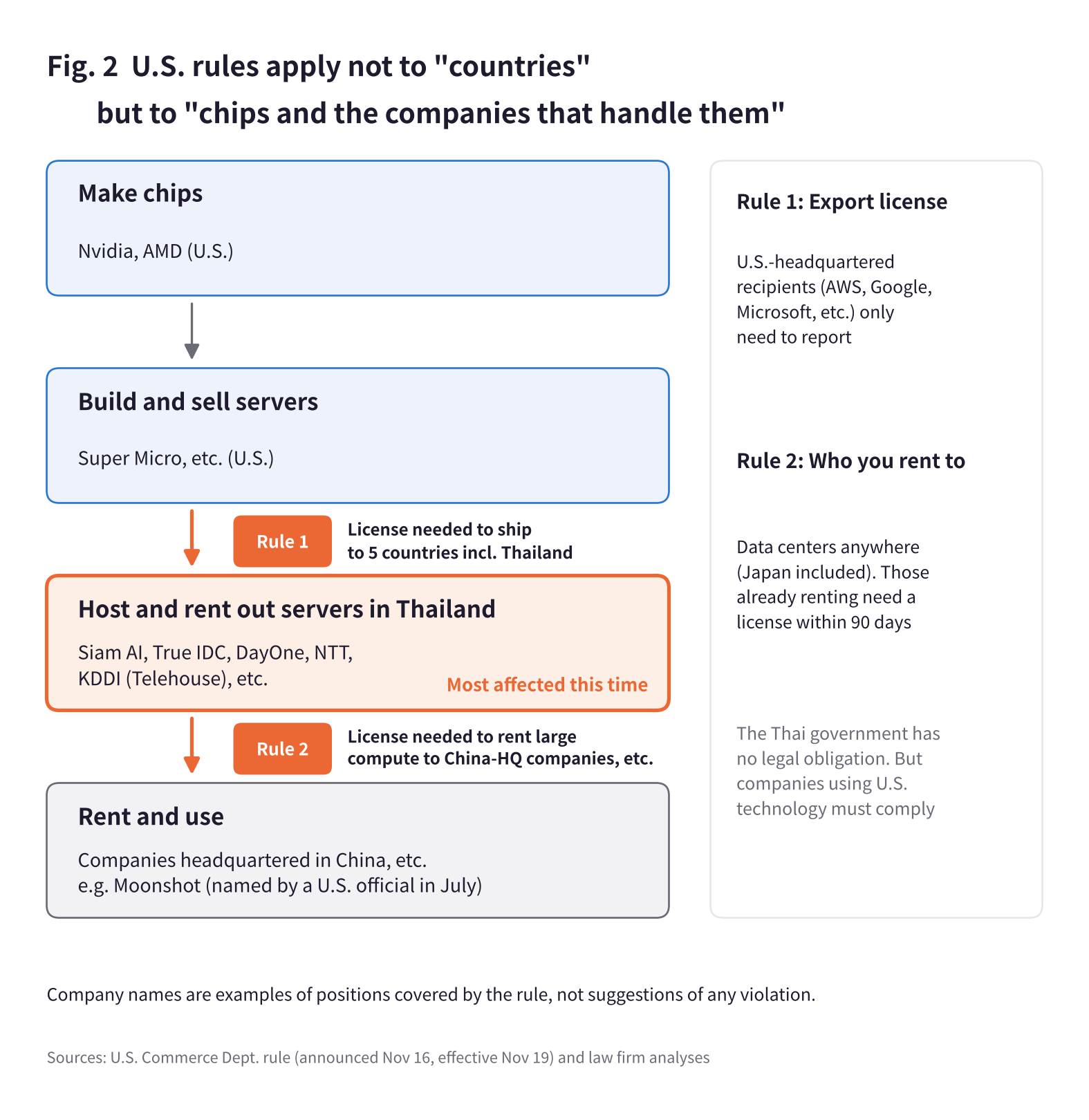
- May 8: Bloomberg reported that "Company-1," the Southeast Asian company left unnamed in a March U.S. indictment, is Bangkok-based OBON Corp. According to the report, some of the roughly $2.5 billion worth of Super Micro servers sold to OBON are suspected of having gone to China, with Alibaba described as one of the end customers.
- According to reports, OBON played a role in setting up Siam AI, Thailand's first Nvidia cloud partner. Siam AI denied ever exporting AI servers to China, and its CEO said he left OBON when he founded Siam AI. Alibaba also denied any business relationship with OBON or Super Micro.
- July 22: Michael Kratsios, director of the White House Office of Science and Technology Policy, posted on X that the Chinese AI company Moonshot (developer of the "Kimi" AI) had "acquired GB300-equipped servers and has accessed GB300s in Thailand, likely to train its AI models." He also alleged that Moonshot had used "distillation" to absorb the capabilities of models from Anthropic. No Thai facility or company was named, and the post presented no evidence. A July 31 report said a large share of Kimi's computing power comes from about 20,000 Nvidia chips under a deal with its investor Alibaba. How much Thai capacity was used is not known.
- Treasury Secretary Bessent said that stealing U.S. models through distillation could lead to sanctions and Entity List designations. As far as I could find, the Thai government has made no formal response to the accusation.
Interpretation
- As of July, renting computing power to Chinese companies from data centers outside the U.S. was described in reports as a gap in U.S. rules. Washington, in effect, named Thailand as an example of that gap.
2. Why U.S. rules reach Thailand
Facts
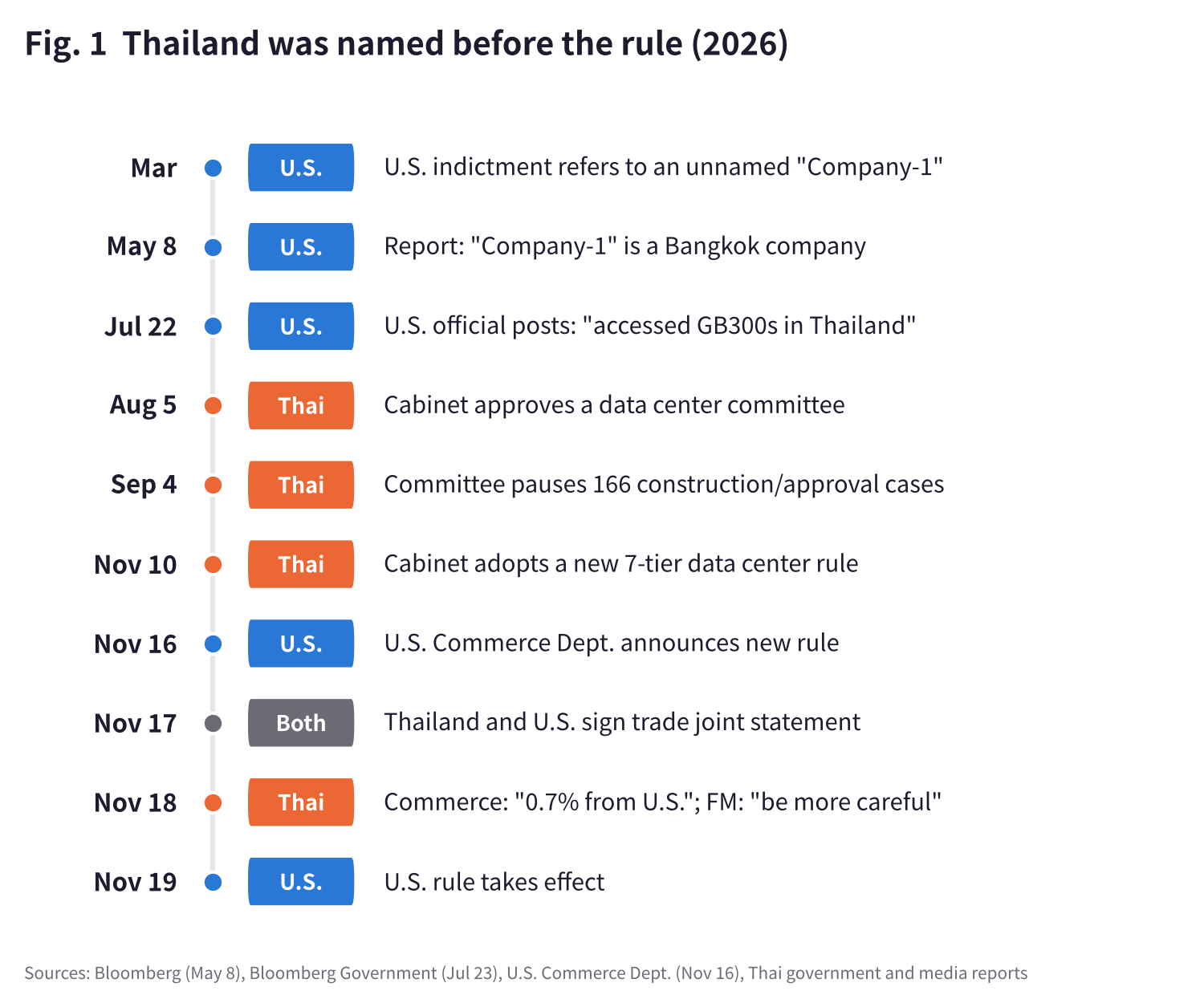
- The U.S. Commerce Department announced a new rule on November 16; it took effect on November 19.
- Rule 1: Exporting advanced AI chips to five countries (Thailand, Malaysia, Singapore, Indonesia and Brazil) requires a license. If the recipient is a U.S.-headquartered company, reporting is enough.
- Rule 2: A data center that provides more than a set amount of computing power (12 million aggregate TPP) to companies headquartered in China or similar countries needs a license. This is not limited to the five countries: it applies to data centers anywhere in the world, including in Japan. Data centers already providing such access must obtain a license within 90 days of the effective date (according to law firm analyses).
- The Thai government has no legal obligation to comply. The rule applies to "chips made with U.S. technology" and to the companies that handle them. A company that violates it may be added to the Entity List, which would make U.S. chips and software hard to obtain. Since most cutting-edge AI chips are designed by U.S. companies, companies that want to stay in business have little choice but to comply.
- Neighboring Malaysia introduced its own license requirement for exporting and transshipping U.S.-made high-performance AI chips in July 2025. It was still included in the same five countries as Thailand. In Thailand's case, its name had already come up as a specific suspicion before the rule, in a U.S. official's post and in reports about the indictment.
3. Is the impact really small? How the Thai government responded
The PM is "confident"; the foreign minister says "be more careful"
Even within the government, responses varied. In date order:
- November 13, Prime Minister AnutinHe is confident Thailand will not be affected. Chinese and American investors say they will continue investments worth several hundred billion baht. (Responding to reports that the U.S. would extend controls to seven countries including Thailand.)
- November 17, Bank of Thailand (assistant governor)If investors show their investments are legitimate and meet U.S. license conditions, the impact will be limited. The central bank will consult with businesses.
- November 18, Commerce Ministry spokespersonThis is not an import ban but case-by-case licensing.
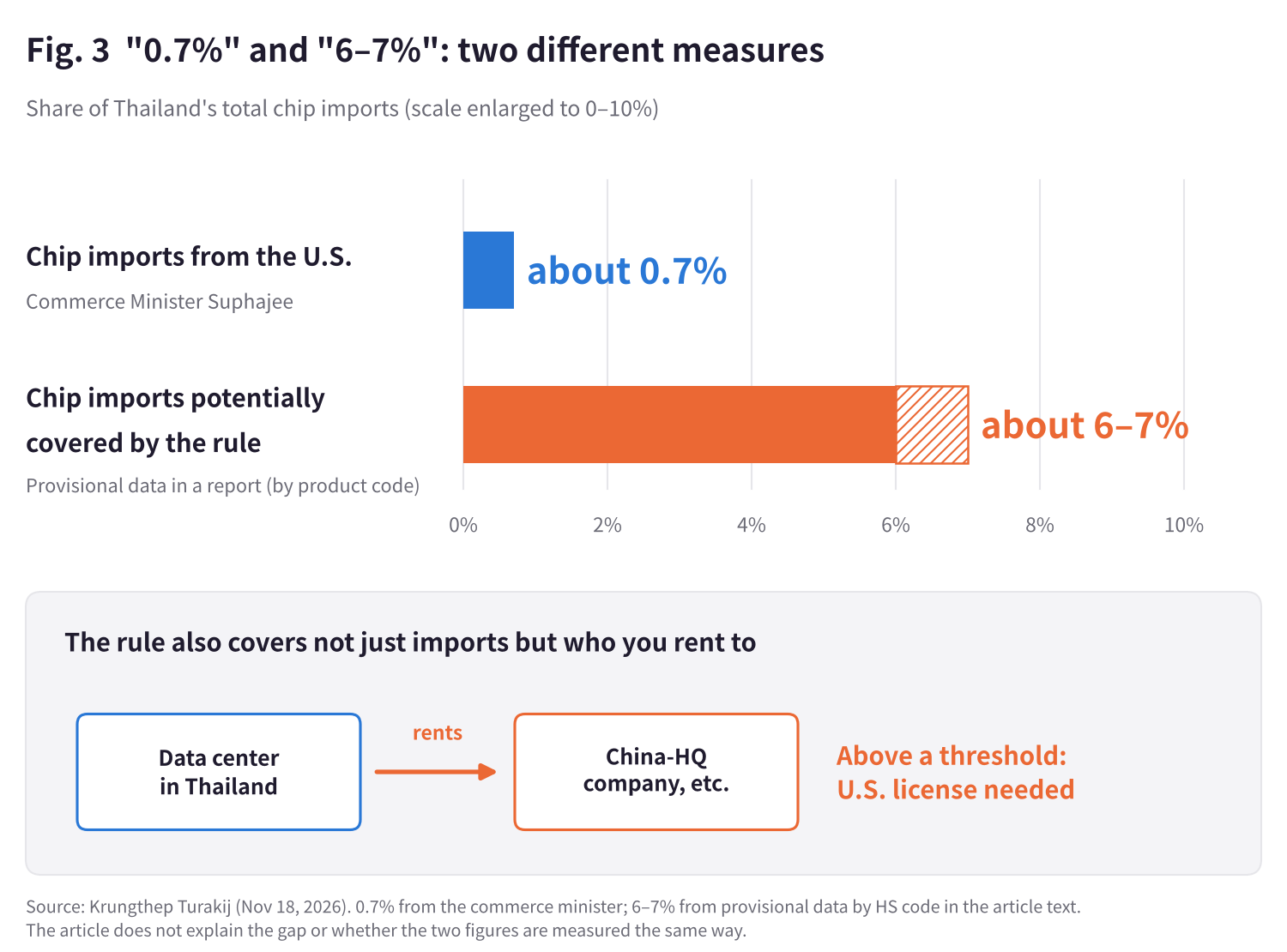
- November 18, Deputy Prime Minister and Commerce Minister SuphajeeChip imports from the U.S. are about 0.7% of the total. The impact may not be large yet.
- Reported November 18, Foreign Minister SihasakIn an interview right after the PM signed the joint statement, he said "we have to be more careful now," and that Thailand will talk with the U.S.
Can we take comfort in "0.7%"?
The commerce minister said chip imports from the U.S. are about 0.7% of the total, and that the impact may not be large yet.
But in my view, the issue is not only how many chips Thailand imports. Some of Thailand's data center business is renting out computing power. This rule also looks at who they rent to. The 0.7% figure does not measure that.
First: the rule applies to who you rent to.
Even if few chips are imported, renting large amounts of computing power to a company headquartered in China or similar countries requires a U.S. license.
Second: chips covered by the rule are not necessarily "chips that came from the U.S."
The rule covers chips made with U.S. technology. Chips made in and shipped from places such as Taiwan may not appear in the "imports from the U.S." figure (interpretation). Separately, according to the Thai newspaper Krungthep Turakij on November 18, provisional data based on the product classifications in the notice put chips potentially covered by the rule at about 6–7% of total imports. The article does not explain the gap between the two figures or whether they are measured the same way.
0.7% alone is no reason for comfort.
On November 26, the Financial Times (FT) reported that Nvidia had told its manufacturing partners to stop shipping servers containing its chips to four countries: Malaysia, Singapore, Thailand and Indonesia. Citing three people familiar with the matter, the FT said partners such as Dell and Super Micro had told customers in the four countries that their orders could not be shipped. It is not known whether this is a temporary measure while companies work through compliance with the new rule.
4. The same week: Thailand–U.S. trade agreement
Facts
- On November 17, Prime Minister Anutin and President Trump signed a joint statement on the substantial conclusion of an Agreement on Reciprocal Trade (ART). The statement does not mention chips. But the framework for the agreement from October 2025 already commits Thailand to cooperate with the U.S. on export controls.
Interpretation
- In my view, the foreign minister's "talk with the U.S." is not only about the chip rule; it cannot be separated from the final negotiations on the trade agreement.
Thailand has also started choosing its own data centers. In September, it paused 166 construction and approval cases, and on November 10 the cabinet adopted a seven-tier rule (November 11 issue, in Japanese). I will write about this in detail in Part (3) on December 2.
My view
A country named first stays under watch
The rule applies equally to the five countries. But in Thailand's case, specific suspicions became public before the rule. I think a country whose name came up first will remain under U.S. scrutiny, both in license reviews and in future revisions of the rule.
Thailand has attracted investment by welcoming both the U.S. and China. From now on, it will have to explain "whom it is welcoming." For a country that has made neutrality its strength, neutrality itself is starting to be questioned.
During World War II, Southeast Asia became a stage for great-power competition over resources such as oil and rubber. What is being contested now is AI computing power and the electricity that runs it. The stage is Southeast Asia again.
Can you explain who your customers are?
If the rule now reaches "who you rent to," then a data center's customer list becomes subject to review. In January 2024, the U.S. Commerce Department proposed requiring U.S. cloud companies to verify their foreign customers (KYC). I think this rule extends the responsibility to know your customer to data centers around the world.
Japanese companies that use data centers in Thailand are not directly regulated. But is your data center complying with the rule? Is there a risk that service stops because a license is not granted? There is one more thing to check.
What happens to the 842 billion baht?
Under Rule 1, a license is not needed (only reporting) mainly when the recipient is a U.S.-headquartered company; there are a few other limited exceptions. So what happens to TikTok's 842.35 billion baht plan approved by the BOI? I will look at this in Part (2) on November 30.
Special Feature No. 6: The Data Center Race
- (1) Named by Washington: Thailand's Data Center Boom: Why Washington Named Thailand (this article)
- (2) TikTok's next move: What happens to TikTok's 840 billion baht in Thailand? (to be published November 30)
- (3) The fight for power: Thailand saying no to data centers? 30,000 MW competing for electricity (to be published December 2)
- (4) Where Japan stands: Thailand's data centers: where is Japan's name? (to be published December 4)
Sources
- BOI PR8/2569 (Jan 15, 2026) / Thairath (Jan 20, 2026, in Thai)
- BOI PR67/2569 (May 6, 2026), TikTok
- Amazon (Jan 8, 2025) / Google (Sep 30, 2024) / Microsoft (May 1, 2024): data center plans in Thailand
- The Star (Jul 5, 2024): BOI approval of Alibaba and Huawei
- U.S. Commerce Department BIS (May 31, 2026): guidance on the license requirement in place since November 2023
- Bloomberg (May 8, 2026) / The Star (May 8 and 10): Alibaba's denial / Thairath English (May 8 and 9): OBON and Siam AI
- Thansettakij: Siam AI statement (in Thai) / Krungthep Turakij (in Thai)
- Bloomberg Government (Jul 23, 2026) / THE STANDARD (in Thai) / Krungthep Turakij (Jul 24, in Thai)
- Thairath English (Jul 23)
- The Star (Reuters, Jul 31, 2026): about 20,000 chips via Alibaba
- U.S. Commerce Department BIS (Nov 16)
- Greenberg Traurig / Squire Patton Boggs / Morgan Lewis / Katten (analyses of the rule; data centers anywhere in the world are covered)
- U.S. Commerce Department BIS (Jan 29, 2024): proposed KYC rule for cloud services
- The Star (Jul 14, 2025): Malaysia
- Thai Post (Nov 13, in Thai)
- Thailand Business News (Nov 19): Bank of Thailand
- Krungthep Turakij (Nov 18, in Thai) / Post Today (Nov 18, in Thai)
- The Edge Malaysia (Nov 18)
- The White House (Nov 17): joint statement
- The White House / USTR (Oct 26, 2025): framework for a U.S.–Thailand Agreement on Reciprocal Trade
- Thai Post (Sep 4, 2026, in Thai): first meeting of the data center policy committee
- Reuters (Nov 26, 2026): FT report on Nvidia halting server shipments